
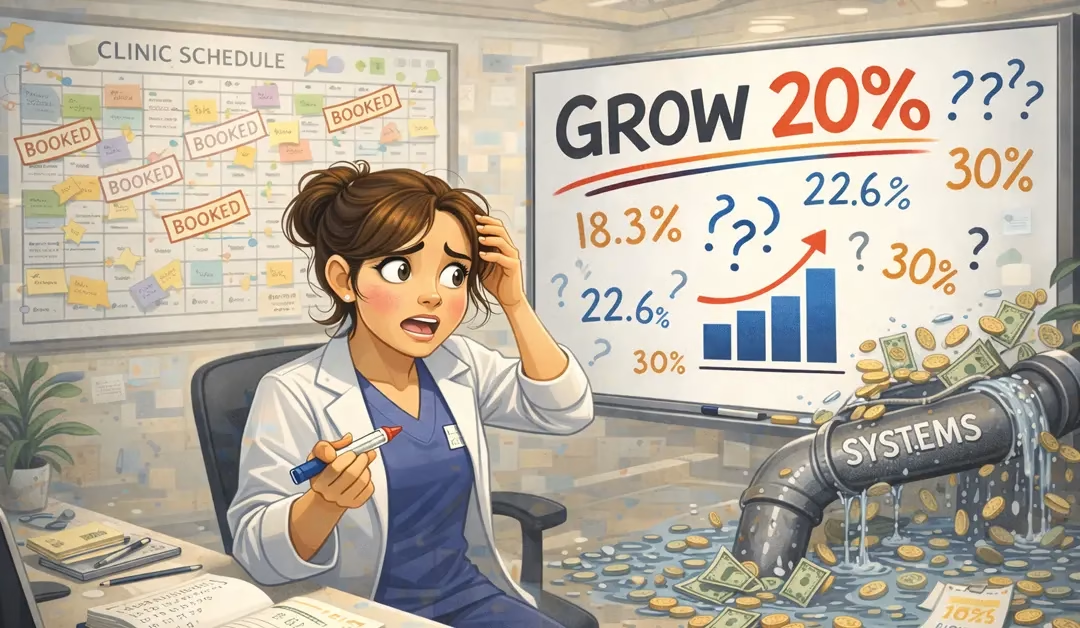
Many med spa business consultants are obsessed with goal-setting. They make it sound like success comes from choosing a number, assigning a percentage, and forcing the team toward it. On paper, it looks professional. In reality, it often produces something else: stress, disappointment, and shallow execution.
The biggest problem is not the existence of goals; it’s the type of goals that get promoted, especially those “clean” numbers like 10%, 15%, or 20% growth. These targets are usually presented as practical and measurable, but most of the time, they are not based on reality. They are not connected to capacity, limitations, or market conditions. They simply sound reasonable, so owners adopt them.
But here is the question no one asks: why 20%? Why not 22.6%? Why not 18.35%? If the business world were as predictable as this advice suggests, then growth targets would not come in round numbers. They would come from real forecasting: real capacity analysis, team productivity assessment, conversion data, client retention cycles, and market demand. Yet most goal-setting advice doesn’t do any of that. It gives owners a “motivational target” that looks strategic and feels disciplined, but in practice becomes an artificial burden.
A med spa does not grow because the owner wrote “+20%” on a board. It grows when the business develops the capacity to grow. Growth is not a wish. Growth is not a decision. Growth is the end result of systems that consistently create higher performance. And those systems are limited by two realities: the capacity of the market, and the capacity of the clinic itself.
This is the part most consultants overlook. The truth is that every clinic has a capacity. Not an emotional limitation, an operational one. Your location, reputation, price point, service mix, staffing model, physical space, schedule efficiency, consultation process, retention system, and leadership capability all create a real limit. Some clinics can grow 30% without breaking because they have operational room, a strong team culture, and high conversion. Other clinics cannot even grow 10% without collapsing into chaos because the business is already fragile and the owner is already overloaded.
So when a consultant says “set a goal to grow 20%,” it ignores a critical question: can your business handle that growth? If you can actually grow 30%, then 20% is under-shooting. But if the real capacity of your clinic is 10% because of staffing, systems, and leadership bandwidth, then 20% becomes a guaranteed source of anxiety. It turns the year into a constant psychological pressure loop: trying harder, pushing more, rushing decisions, and then feeling like something is wrong with you because you didn’t hit the set goal.
This is why owners feel stuck, even when they are working harder every year. They think they are failing at growth, when the truth is that they are trying to grow faster than their infrastructure allows. And that is exactly how clinics become “busy but broke”: the calendar fills up, the team burns out, the owner becomes reactive, costs rise, cash flow becomes unstable, and profit refuses to match the effort.
The smarter approach is to stop treating growth like a percentage and start treating it like a natural outcome of stability. Instead of saying “we must increase revenue by 20%,” the better question is: what systems must exist so that growth becomes inevitable and sustainable? In other words, don’t chase growth. Build the machine that grows.
A perfect example is retail sales. Many med spa resources suggest setting a goal like “increase retail by 20% in two months.” The first problem is obvious: where did that number come from? If someone claims 20% is achievable, they should be able to explain the math behind it. What is the current baseline? What is the current attachment rate? How many clients actually receive product recommendations? How many clients trust those recommendations? How consistent is the staff? How strong is training? How effective is follow-up? How optimized is merchandising and inventory? Without these answers, a 20% target is not a strategy; it is a random expectation.
The deeper issue is that retail growth is not a numbers problem. It is a behavior and system problem. If you want retail to increase, you don’t need a percentage on a board. You need a protocol that produces consistent behavior in every treatment room, every time. The goal should not be a percentage. The goal should be a standard.
For example, instead of demanding “20% retail growth,” you install a team expectation that every provider presents at least three products related to the service the client just received. You train the staff on how to recommend without being pushy. You teach framing: “Here’s what we did today, here’s what you need at home to protect the results.” You ensure compliance. You make it a routine. You track it. You coach it. You repeat it until it becomes culture.
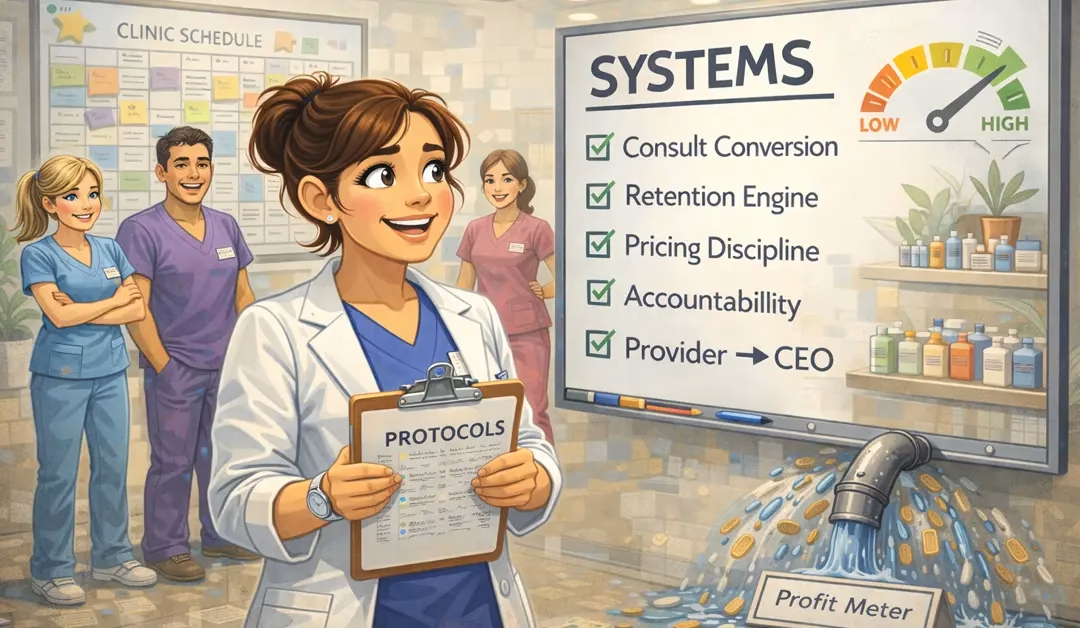
At that point, retail growth becomes a byproduct. If it increases by 1%, it’s still a win, because it means the system is working and is now installed. And if it increases by 50%, it is not a surprise; it’s what happens when you apply a consistent method repeatedly. The key is that this type of growth is stable. It doesn’t require constant pressure. It doesn’t collapse when the owner gets tired. It doesn’t depend on motivation. It depends on the structure.
This exposes another weakness of “goal obsession.” Often, the only way to hit those artificial growth targets is by doing the work that should have been done anyway: better training, stronger leadership, clearer roles, consistent accountability, improved conversion systems, improved retention systems, and smarter reinvestment. But if those actions are the real drivers of growth, why are they framed as tools to chase a number? Why weren’t they installed earlier?
This is where many med spa owners feel a hidden frustration. They sense that the numbers are not guiding the business; the numbers are simply pressuring the business. They feel as if they are being told to manufacture growth instead of building strength. And when stress rises, decision-making quality drops. Owners start reacting emotionally: discounting to push demand, hiring too quickly, spending money without a plan, tolerating toxic staff because “we can’t lose people right now,” or taking low-quality clients because “we need to hit targets.” This is the exact opposite of premium, stable growth. It creates chaos.
In owner-led clinics, especially med spas, this becomes even more dangerous because the owner’s internal condition shapes the whole business. When the owner is stressed, the business becomes reactive. When the owner is anxious, the team feels it. When the owner is chasing a number, decisions become short-term. It’s not because the owner is weak; it’s because stress hijacks leadership. This is why I say growth does not begin in spreadsheets. It begins in the internal operating system of the business owner: how decisions are made under pressure, how boundaries are held, and how standards are enforced.
So instead of writing “grow 20%,” the better goal is to create a healthier environment that allows growth to happen naturally, not because you forced it, but because the business finally became capable of it. That means installing systems and protocols that reduce leakage and stabilize execution. It means building a clinic that converts consistently, retains clients consistently, and runs consistently even when the owner is not in the building.

When you do that, growth becomes the natural outcome of maturity. The clinic grows to the degree that it can handle. It meets the capacity of the market without destroying itself internally. That is the type of growth that increases valuation, increases owner freedom, increases team stability, and reduces burnout.
A med spa should not grow based on a random percentage written on a board. It should grow based on its real capacity, market capacity, and internal capacity. When your systems are healthy, your team’s behavior is consistent, and the owner is leading instead of firefighting, growth stops being a stressful target and starts becoming a predictable result. That is a real business strategy.