How to Stop Workplace Drama in Your Med Spa Before It Destroys Your Business
Most med spa owners and clinic managers have experienced it. A staff member pulls you aside to complain about a colleague. Two team members stop speaking to each other. Gossip spreads through the break room. Someone threatens to quit over a scheduling disagreement. On the surface, it looks like a personality conflict. In reality, it is one of the most expensive and underestimated problems in the aesthetics industry.
Workplace drama in med spas and beauty clinics is not just uncomfortable. It is a direct threat to client retention, staff stability, revenue consistency, and the mental health of everyone in the building, including the owner. Understanding why drama happens and, more importantly, how to stop it, is one of the highest-leverage moves any owner or manager can make.
Why Drama Starts in Med Spas and Beauty Clinics
The beauty and aesthetics industry attracts highly driven, creative, and emotionally engaged professionals. These are people who care deeply about their skills, their clients, and their standing within the team. When the work environment does not provide clear expectations, consistent leadership, and a fair structure, this same emotional investment that makes great practitioners can turn into friction, unhealthy communication, and conflict.
Several specific conditions create the environment for workplace drama:
Unclear expectations and inconsistent standards allow different team members to interpret rules differently, which creates resentment and comparison. When one person is held accountable and another is not, trust in leadership collapses quickly.
Favoritism, even when unintentional, is one of the most damaging factors in a small clinical team. When managers or owners give preferential treatment to certain staff members, whether in scheduling, commission, tone, or flexibility, the rest of the team notices immediately. Over time, this becomes the source of gossip, passive aggression, and high turnover.
Lack of clear communication leaves too much room for assumption. In a fast-moving clinic, if roles are not clearly defined and decisions are not explained, staff fill the silence with speculation. That speculation becomes rumor, and rumor becomes drama, and if you don’t act quickly and promptly it grows.
Owner or manager anxiety is a rarely discussed but highly influential factor. When leadership is unpredictable, overly reactive, or emotionally inconsistent, the team mirrors that instability. Staff begin to act cautiously, form protective groups, and lose trust in the fairness of the environment. Drama is often less about the staff and more about the environment that leadership has created, intentionally or not.
The Real Cost of Drama You Are Not Tracking
Before addressing how to stop drama, it is important to recognize the full cost of allowing it to continue. Most owners underestimate how much workplace conflict drains from their business.
Client experience is directly impacted. Clients who come to a med spa for relaxation, care, and confidence are highly sensitive to the emotional tone of the environment. When the team is tense, competitive, or distracted by internal conflict, clients feel it. They may not be able to articulate why, but they will stop returning. Studies in service industries suggest that emotional environment and staff cohesion directly influence client loyalty decisions in a significant portion of repeat-visit choices.
Staff turnover becomes a recurring expense. Replacing a skilled aesthetic practitioner or experienced front desk team member costs far more than most owners realize when factoring in recruitment, onboarding, training, and lost productivity. Drama-filled environments push good employees out and attract those who thrive in chaos.
Owner mental load increases dramatically. Managing interpersonal conflict on top of clinical responsibilities, financial pressure, compliance, and marketing is exhausting. Many owners report that staff drama is among the top sources of their daily stress, and chronic stress reduces the quality of every other business decision they make.
How to Actually Stop the Drama
Stopping workplace drama is not about enforcing a zero-tolerance policy or threatening consequences. It is about removing the conditions that allow drama to grow in the first place. Here is a structured approach that works for both owners and clinic managers.
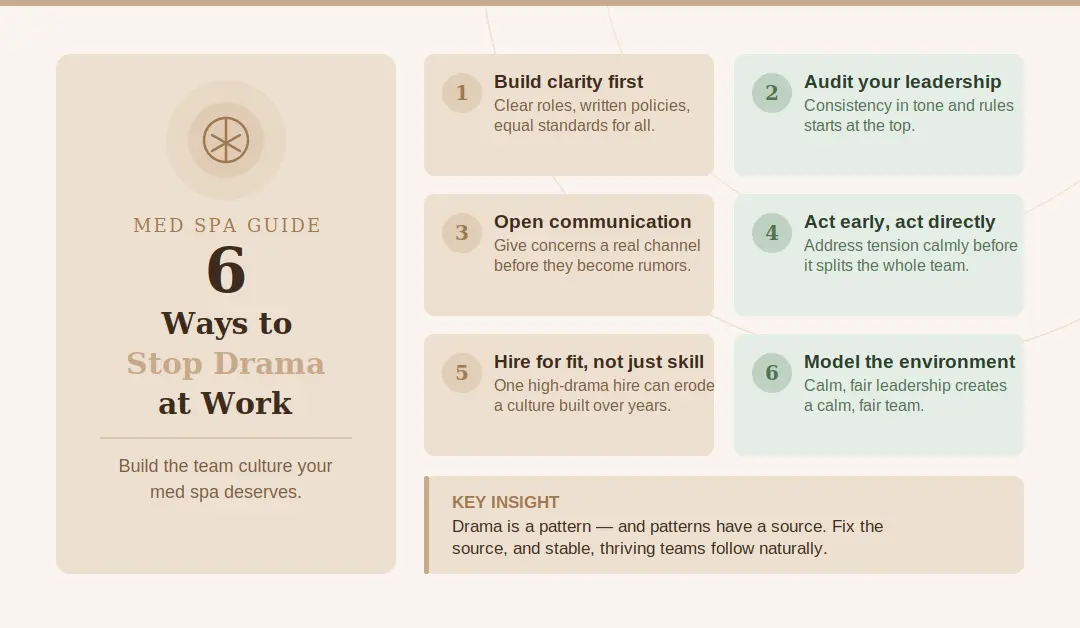
1. Build clarity before conflict happens
The most effective anti-drama tool is a clear, consistently applied set of expectations. This means documented role descriptions (SOPs), transparent commission and scheduling policies, and unambiguous standards for behavior and performance. When everyone knows the rules and sees them applied equally, there is far less room for a sense of unfairness to take root.
Write it down. Share it during onboarding. Review it regularly. The goal is not to create a bureaucratic manual but to remove ambiguity and unclear expectations, which is the breeding ground for drama.
2. Audit your own leadership patterns
This is the most uncomfortable but most important step. As an owner or manager, your behavior sets the tone for the entire team. If you make exceptions for certain staff members, react inconsistently under pressure, express frustration openly, or share unnecessary information and even worse unevenly, you are creating the conditions for drama, whether you intend to or not.
Ask yourself honestly: Are my expectations clear and consistent? Do I treat all team members by the same standard? Am I emotionally stable and predictable in how I lead? If the answer to any of these is uncertain, that is where the work begins.
3. Create structured communication channels
Drama often arises where there is no proper communication among staff. If staff have no formal way to raise concerns, share feedback, or discuss problems, they will do it informally, with each other, behind closed doors.
Implement brief one-on-one check-ins. Create a process for staff to raise concerns directly with management. Hold short team meetings where updates are shared openly. The goal is not to turn the clinic into a therapy session but to make sure that legitimate concerns have a place to go before they become interpersonal conflicts.
4. Address issues early and directly
One of the most common management mistakes is avoiding difficult conversations in the hope that problems will resolve themselves. They rarely do. What starts as a minor tension between two team members grows into a team-wide division when leadership does not address it promptly.
This does not mean reacting emotionally or publicly. It means having a calm, private, direct conversation with the person or people involved as soon as you notice a problem emerging. State what you have observed, explain the impact, and make expectations clear going forward.
5. Evaluate fit, not just skill
Hiring decisions in the beauty and aesthetics industry often prioritize technical skill above everything else. A talented injector or esthetician who consistently creates conflict, ignores boundaries, or undermines teamwork is not an asset, regardless of their clinical abilities. Over time, one high-drama employee can damage your team culture more than any marketing challenge or operational problem.
During hiring, assess behavioral patterns, communication style, and how a candidate handles disagreement. During employment, recognize that repeatedly tolerating destructive behavior sends a message to the rest of your team about what is acceptable.
6. Model the environment you want
Ultimately, the culture of a med spa or beauty clinic reflects its leadership. A calm, fair, communicative, and consistent owner or manager creates a team that mirrors those qualities. An anxious, reactive, inconsistent, or conflict-avoidant leader creates a team that mirrors those qualities instead.
This does not mean being perfect. It means being intentional. Every interaction you have with your team, in public and in private, shapes the environment they work in. When leadership is stable, the team tends to be stable. When leadership is clear, the team tends to be clear. When leadership addresses problems directly, the team learns to do the same.
When Drama Is a Symptom, Not the Problem
It is worth acknowledging that in some cases, ongoing or recurring drama is a signal of a deeper structural or leadership issue inside the business. If conflict keeps returning despite your best efforts, it is worth examining whether the root cause is something more fundamental: unclear ownership of responsibilities, financial pressure creating team stress, an inconsistent service structure, or an internal environment that has been unstable for too long.
In these cases, addressing the interpersonal conflict alone will not create lasting stability. The deeper pattern needs to be identified and corrected at the basic and structural level.
Drama in the med spa and beauty workplace is not inevitable. It is a pattern, and like all patterns, it has a source. When owners and managers take the time to understand the source, whether it is in unclear expectations, inconsistent leadership, poor communication channels, or hiring decisions, they can address it directly and create an environment where skilled professionals thrive, clients feel the difference, and the business becomes genuinely stable from the inside out.
The most successful med spas are not the ones that never face conflict. They are the ones led by people who know how to address it, prevent it from repeating, and build a team culture where drama has very little room to grow.